
UC Santa Cruz’s Fight for a Liberated Palestine: A Long-Existing Struggle
Author
SM Web Dev
Share
Written by Hayley Sanchez
Photos by Mar Cisneros
Copy edited by Roberto Osorio and Andrea Reynoso
Student actions and calls for ending occupations and exploitative powers are a historical part of UCSC’s environment. This rich history is seen in the TWANAS (the Communities of People of Color Student Press) archives which date back to about 1979. In the archives, there is a 1981 piece by Urion Heath called TWANAS Hunger Strike, which covers the hunger strike in the fight for Third World Studies. In describing the fight, the article reads as the following:
“We have brought shame and disgrace to the people who run this University, and it is not necessary to mention any names. We have been lied to, misled, and treated in a most condescending manner… but we understand that these people chose to play this role, to be used by each other in covering up each other’s lies until they use each other up and become useless for even themselves.”
In 2018, TWANAS covered a “die-in” protest where organizers from Students for Justice of Palestine (SJP) called attention to the massive deaths caused by Zionist violence. They laid on the ground to emulate the ongoing violence Israel commits against Palestinians. The article describes the impact of the action when a SJP member at the time, Issa, met someone in Gaza who “applauded the UCSC students for their plan and said that international solidarity is what will drive the resistance.”
There are over 75 years of information that document how Israel has occupied Palestine through genocide, forced displacement, and discriminatory policies. There can be no “democracy” on occupied land when Israel Occupational Forces (IOF) police Palestinians with checkpoints, citizenship classification, village raids, and unprompted interrogations. This has led to mass disappearances, displacement, and death; Palestinians have been forced to be refugees on their own land.
This organized violence carried out by Israel has existed long before the events of October 7th, which were used to justify a new extreme of violence. Israel’s Prime Minister, Benjamin Netanyahu, has continuously bombed and airstriked hospitals, refugee camps, and villages. Within 5 months, his military force killed over 32,000 people. According to the Institute for Middle East Understanding (IMEU), children have accounted for 40% of the deaths. This number is most likely an underestimate as many bodies have yet to be accounted for. Additionally, according to AP News, the United States has continuously rejected a ceasefire that would have halted the ongoing violence.
Social media and Palestinian journalists such as Bisan Owda, Hind Khoudary, and Plestia Alaqad, have brought to light the realities of the Palestinian people, waking the nation to Israel’s crimes. It took millions of reposts exposing children’s dismembered bodies, mothers carrying their childrens’ corpses, and showing unidentifiable body parts under rubble to induce empathy upon the majority of the U.S. population and the rest of the world. However, Palestinians, student and community organizers, human rights organizations, authors, and political activists have been talking about the violence for decades.
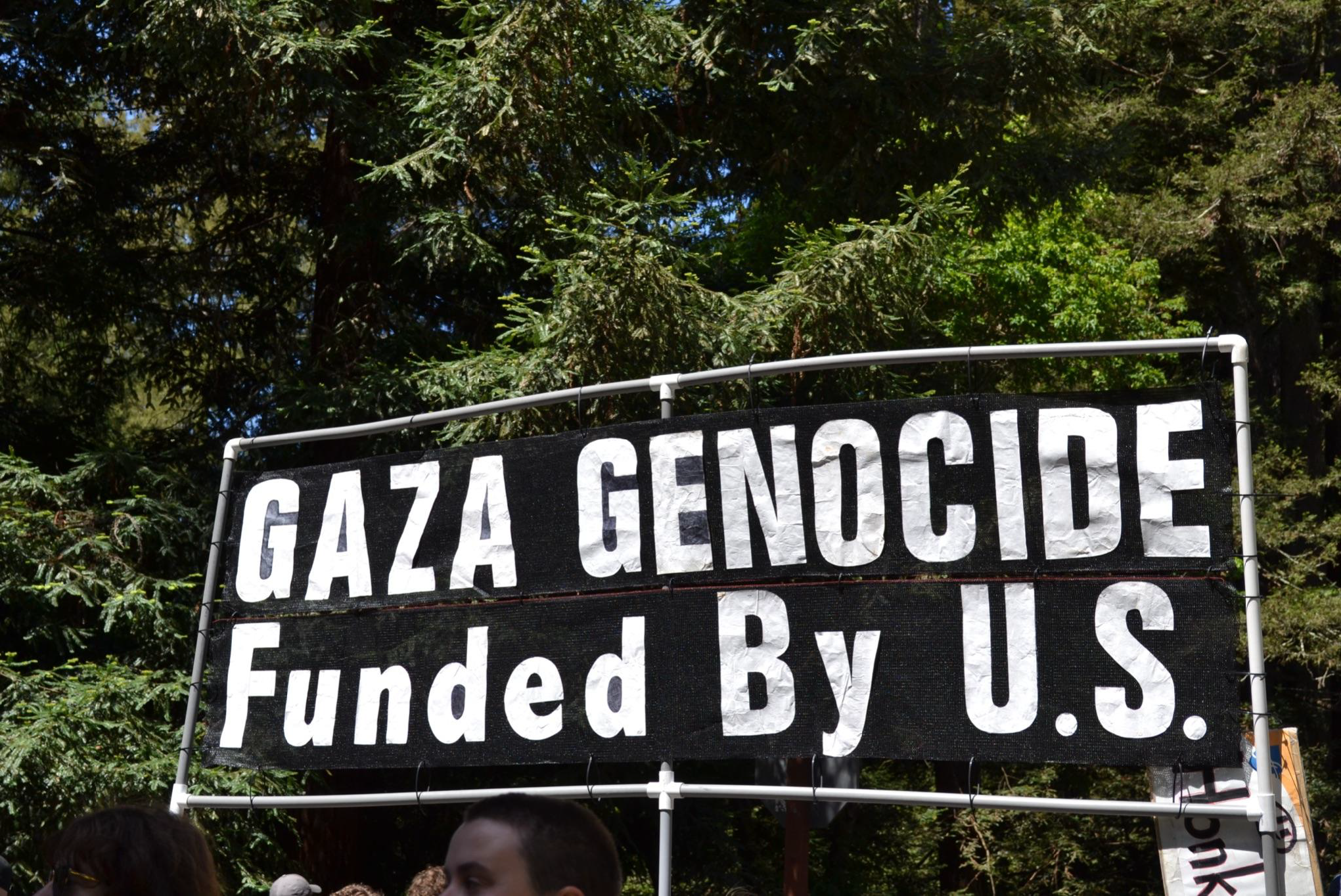
Throughout the nation, this awakening led to the development of student actions, from rallies to encampments. Students from both public and private universities and colleges have gathered to advocate for a permanent ceasefire and Palestinian liberation. They also have demanded divestment of university/college funds invested into Israel to be redirected to student needs. Now, Columbia University, Brown University, Northwestern University, NYU, USC, Cal State University Los Angeles, Cal State University, Humboldt, UCLA, UC Irvine, UC Riverside, UC Santa Barbara, UC San Diego, UC Berkeley, and UC Santa Cruz and have begun encampments with many more joining. All have been met with violence from police, administrators, and zionists, some to the extremity of mass arrests and removal of encampments as have been seen at UCLA, UCSD, Columbia University, and Cal State University, Humboldt. Despite their efforts, students continue to collectively gather together and resume the encampments.
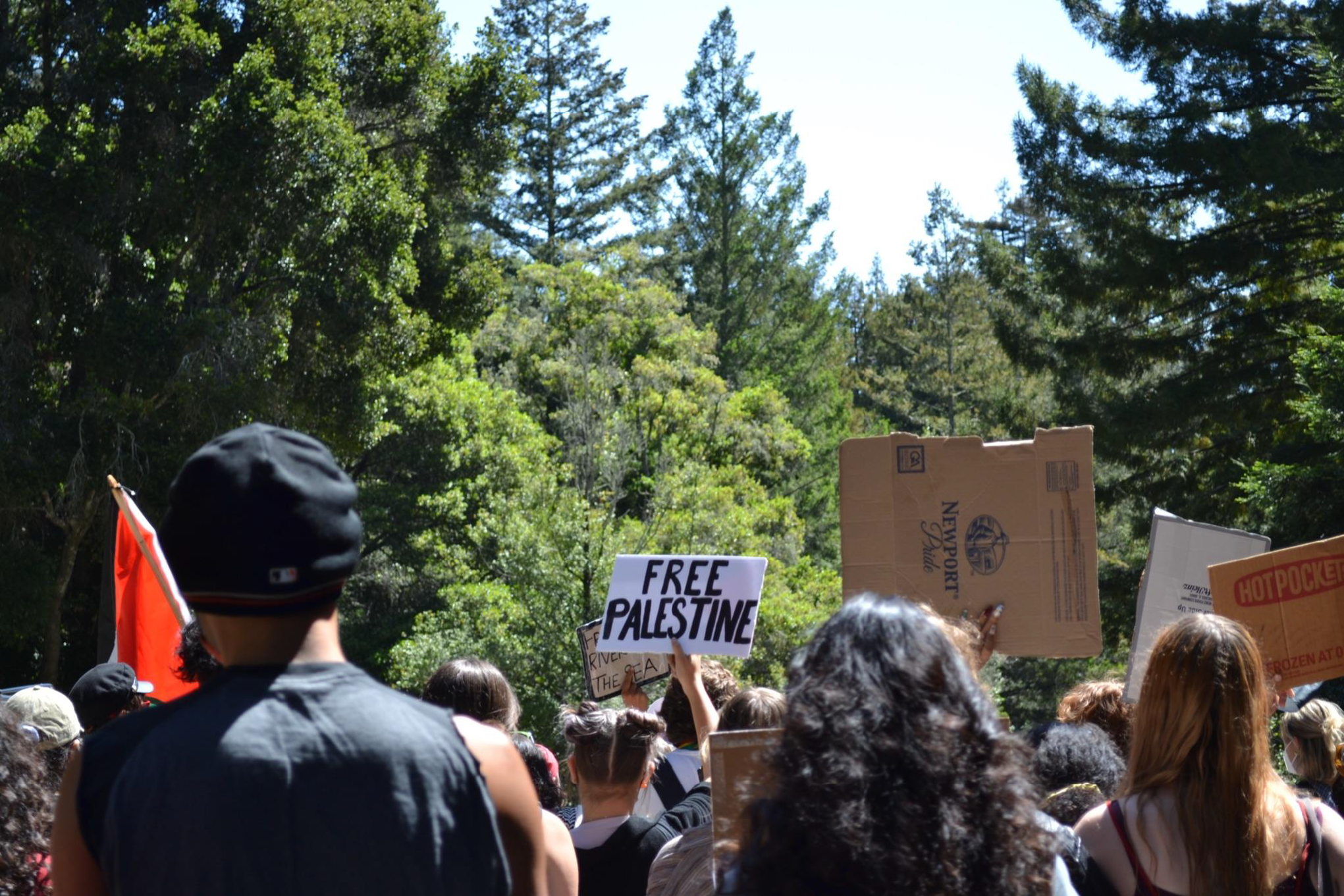
Photo by Mar Cisneros
These protests and encampments are often led by Students for Justice of Palestine (SJP) and SJP National in collaboration with other organizations related to each particular campus such as the UC Divest coalition. SJP’s nationwide demands include:
- Divestment from weapon manufacturers, and invest in students
- Disclose, provide full transparency to all UC wide and UCSC foundation assets
- Complete academic boycott from all Zionist institutions
- End academic repression that target pro-Palestine student protestors, protect free speech, rollback on charges against protestors
- Cops off campus, stop the surveillance and violence
- End the silence, the UC must acknowledge the genocide, and call for an immediate and permanent ceasefire
At UC Santa Cruz, student mobilizations can be seen starting on April 30th when an autonomous student group took over the Rachel Carson/Oakes dining hall. This action addressed food insecurity as the majority of UCSC students lack accessibility to food due to rising costs of dining hall plans, overpriced on campus markets and cafes, low wages, and exploitative work environments.
On May 1st, campus student and workers’ issues were addressed alongside a focus on Palestinian Liberation. Student and Community organizers from the Revolutionary Student Organization Santa Cruz (RSO), Gabriela Santa Cruz, Anakbayan Santa Cruz, the Workers Solidarity Coalition, the Student Dining Workers Union, AFSCME 3299, and UAW Local 4811 organized a May Day Rally on May 1st, also known as International Workers’ Day. This day honors and celebrates workers from all disciplines and from all countries. Unsurprisingly, the United States is one of the few countries that does not recognize May Day because the holiday supposedly had communist ties, instead creating Labor Day. The purpose of this rally was to bring to light the harsh realities of student and university workers by giving labor unions such as AFSCME a platform to inform and call to action.

Photo by Mar Cisneros
The May Day rally began outside the Science Engineering Library at 11:00 am and by 11:15 am hundreds of students and faculty had joined. Some were from Faculty for Justice of Palestine (FJP), who showed up in their doctoral regalia and joined with signs in support of student and university workers, and in solidarity with Palestine. Echoes from the hundred of protestors could be held throughout campus as they repeatedly chanted, “Workers and oppressed people of the world unite,” “Gaza, Gaza, you will rise, students are by your side,” and “Gaza, Gaza, you will rise, workers are by your side.”
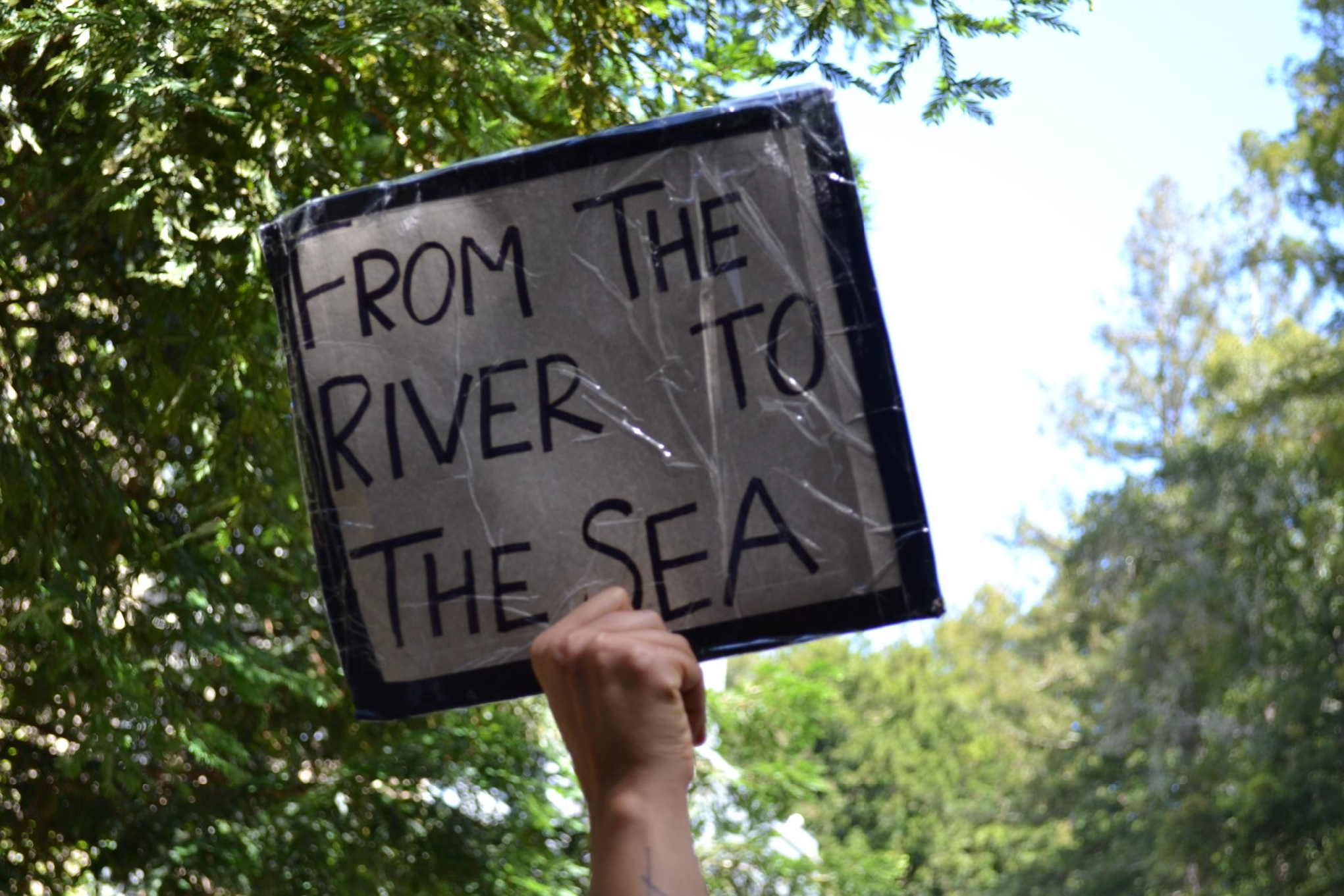
Photo by Mar Cisneros
Student representatives from Camper’s Park spoke on the urgent conditions saying: “Camper Park is a community of resistance, one that came to be over urgent necessity, insistent demand, and student led action. As you may know, two weeks before spring break, Camper Park residents were told that they had to leave immediately because of unsustainable living conditions. Then, after a suggestion to cut our propane, we are allowed to stay until the end of our housing contract. But the fight is not over, camper park is not only the most affordable campus living option, but one rich with stories of shared space, weekly potlucks, and unconditional support. There is still no plan for the future of camper park”
A representative from Gabriela Santa Cruz (The grass-roots based alliance of progressive Filipino women’s organization, named after Gabriela Silang) described their frustrations: “I’m so sick of people telling me to empathize with the other side, because how could I empathize with the side that is so unbothered by so much blood, the blood of the Palestinian people. As an Indigenous Khmai woman, who’s family witnessed Nakba a few years before 1948, the death of my people, as all children of immigrants, children of workers, the blood of our people… how dare they.”
The rally later moved to the street and headed down to Quarry Plaza, where students setting up the encampments awaited. As of now, the encampment has occupied the Graduate Student Commons, the patio of the Student Union Building and the Redwood Lounge, but will continue to expand as more and more students show up in solidarity until the demands are met.
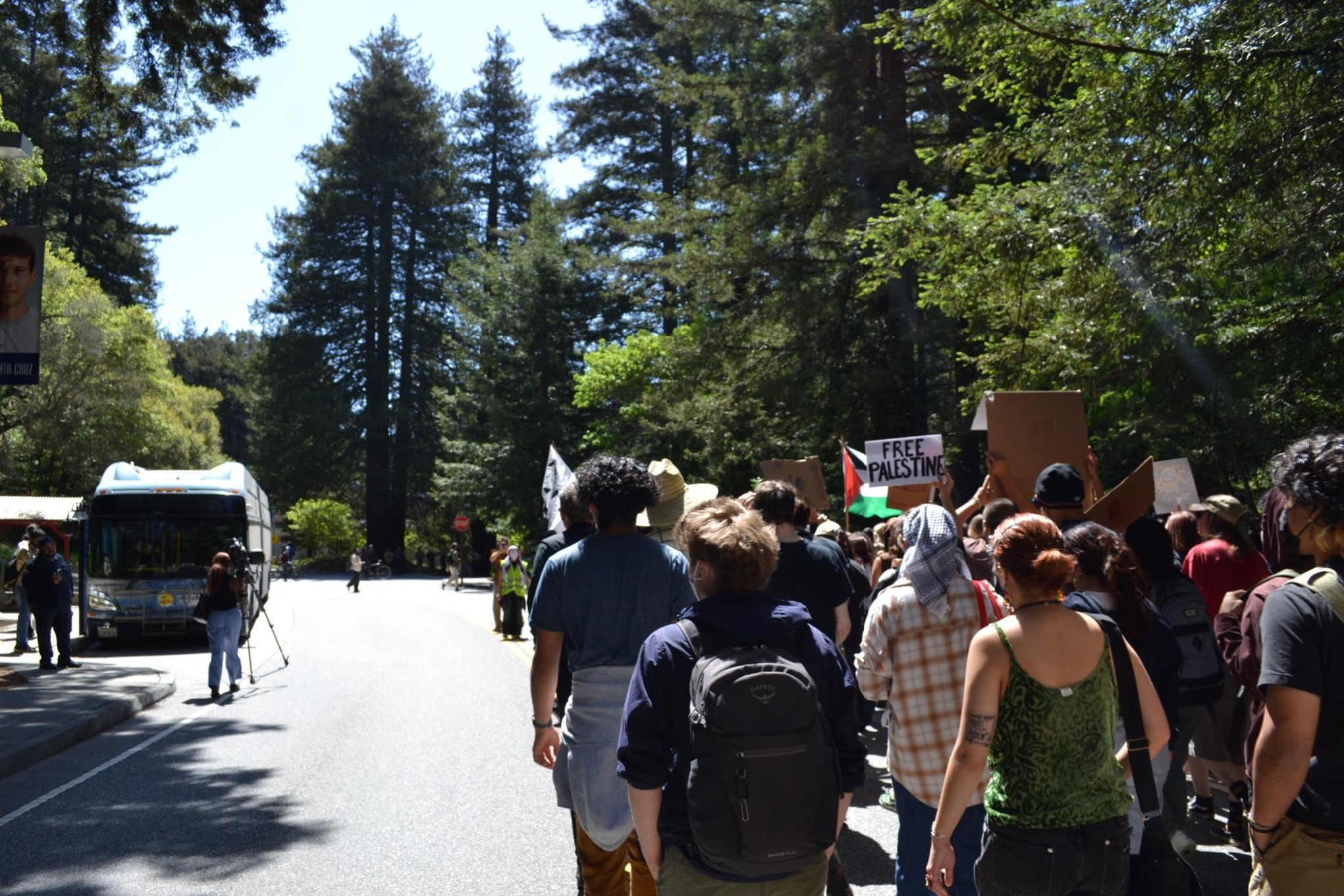
Photo by Mar Cisneros
Amidst arrival at Quarry Plaza, students merged from both outside and inside the encampments, where representatives from ACSME, Anakbayan, Gabriela, the Student Workers Union, and UC Divest spoke. ACSME representative, Nico, stated: “In my 30 years of working here, this is the biggest crowd I have seen.”

Nico, ACSME member (Photo by Mar Cisneros)
Here, everyone demanded that their needs be met. Students called for the divestment from corporations associated with Israel such as Lockhead Martin and Blackstone, and adherence to the BDS Movement, which leads boycotts and sanctions that support Palestinian liberation. Additionally, students put pressure on the University to address the growing student houseless population, food insecurity, and unfair working wages that plague student and workers’ lives.
Daily itineraries were introduced and continue to be organized. The May 1st demonstration included a teach-in, a Mariachi Eterno and Los Mejicas folklórico performance, a community forum, and a “Know Your Rights” training.

Photo by Mar Cisneros
When speaking to protestors, and their reasoning for coming to the protests, a 4th year student mentioned how “These issues aren’t so far from home as we see parallels with what is happening between Israel and Palestine with what is is happening at Columbia University, where food and water have been controlled and cut from protestors, imperialism is still present within university walls and, if people could be more aware, it might keep people more involved.”
A 2nd year grad student TA mentioned one of their most horrific personal experiences going to Palestine in their 20s when taking advantage of their birthright trip to witness the realities of Palestinian people as they stayed in Hebron and at refugee camps. They stated, “When looking at the separation wall, an IDF soldier pointed to a group of Palestinian children playing with a ball and said he was going to kill them if we didn’t leave, because he couldn’t kill us, but he could kill them.”
A 4th year first-gen RA mentioned their reasoning for coming by saying, “Do you want to remember this point of your life as you staying in because you were too scared? We see these students at elite institutions like Yale and Columbia showing out, because ‘they have nothing to lose.’ . I think it’s more powerful when students like us, that are people of color and low income, show face ‘cuz it means a lot, but also remembering our positionality and staying safe. If you’re an RA, you need to be out here and telling your community what is going on, and as an RA I have seen many 1st to 5th year students struggle with housing so being here today isn’t just a free Palestine movement, it is also to hold the university accountable.”
The encampments, contrary to what is portrayed by popular media outlets as conflicts of violence and disturbance, are a safe haven for students. They receive three meals a day (donated by different faculty, volunteers/supporters such as Food not Bombs) and receive health care as on-site EMT’s are present at all times. They also have a space to coalesce, organize, have critical discussions, show support, create art, and collectively heal. Capitalist systems strip our ability to exist in community and nature. This encampment resembled more of a communal village and less of a battlefield, which has been portrayed. There is a sense of safety and protection that is felt by all, both inwardly and outwardly, as one feels protected and feels the need to protect. The only violence at these encampments have been brought by police, zionists, mass surveillance, and administrators.

Photo by Mar Cisneros
This movement/encampment is birthed from students’ love—love for life, love for one another, love for community, love for human rights, love for the natural environment, and love for Palestine. The movement highlights the interconnectedness between Palestine and all other countries and communities that have been harmed, displaced, and destroyed by capitalist, imperialist, and colonial powers. Unfortunately, these realities continue to be prevalent in our day to day as human rights become privileges, where access to safety, food, water, housing, education, one’s own land, and community have become luxuries instead of a natural given right.
This encampment/movement and fight resembles many student revolutions found throughout history across universities, communities, countries, and time. This includes TWANAS’ own history as the fight for Third World studies, now known as ethnic studies, began with a hunger strike and at the time was deemed “too radical.” It was not peacefully responded to. Students were harmed, incarcerated, and defamed by those in power including administration, the government, and popular media.
We hope the reality moving forward is that we view our issues as being interconnected and ultimately one. We hope international issues continue to be addressed and students around the world stand in solidarity, as students in the U.S. have done for Palestine, and how students in UNAM, Mexico have done in solidarity with U.S. students in response to the repression we have received for our support of Palestine and holding institutions accountable.
This state divides and separates as it has always done. Now is a time when consciousness is being awakened and Amerikkka’s white-pointed veil is being lifted. The nation is coming to an understanding that white supremacy has always existed; it just continues to morph into different forms, different definitions, and at this moment in time is found through zionism.
TWANAS stands in solidarity with Palestine, SJP, and UC Divest orgs in the fight for the liberation of Palestine and all occupied or displaced people, as well as support and advocate for all of the demands to be met. Let us all work as a collective to re-center what home means for us, creating homes full of safety, protection, food, water, love, and community.
LET US COLLECTIVELY MOBILIZE IN THE FIGHT FOR LIBERATION & JUSTICE FOR ALL PEOPLE.
Love & Solidarity,
TWANAS


